Most people assume that successful projects begin with an opportunity and end with investment.
- A piece of land is identified.
- Capital is secured.
- Development begins.
- From a distance, the process appears relatively straightforward.
The reality is very different.
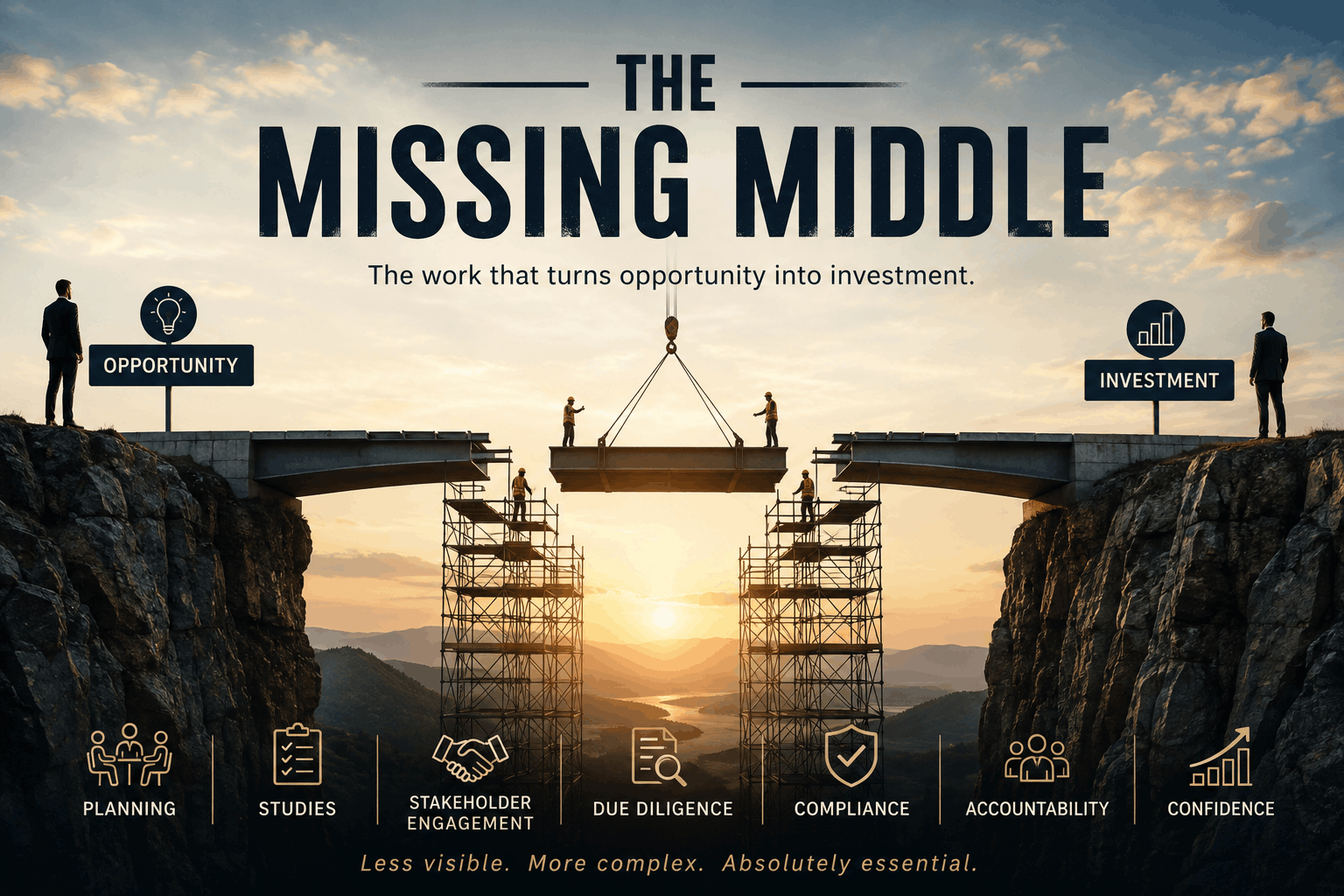
Between opportunity and investment lies a vast amount of work that is rarely visible to outsiders.
This is the missing middle.
And in our experience, it is where projects are either created or destroyed.
Everyone Sees the Beginning and the End
- Investors often see the opportunity.
- A government sees economic development.
- A community sees the possibility of jobs and infrastructure.
- An operator sees future production.
What few people see are the hundreds of activities required to transform an idea into a project capable of attracting serious capital.
The public sees the beginning.
The public sees the end.
Very few people see the journey in between.
Yet that journey determines whether a project succeeds.
Planning Is Not a Phase
One of the first lessons we learned is that planning is not a phase of development.
Planning is development.
- Successful projects begin with understanding who will do what, when, how and why.
- Roles must be clearly defined.
- Responsibilities must be assigned.
- Dependencies must be understood.
- Timelines must be realistic.
Even then, surprises are inevitable.
No matter how well prepared a team may be, something will happen that was not anticipated.
- A document will be delayed.
- A study will require additional work.
- A stakeholder will request clarification.
- A process that should take a week may require a month.
The objective of planning is not to eliminate uncertainty.
It is to be prepared for it.
Institutional Investors Have Institutional Requirements
Many projects underestimate the requirements of institutional capital.
Investors are not simply evaluating an opportunity.
They are evaluating risk.
And they themselves operate under increasingly demanding regulatory and governance frameworks.
- Anti-bribery requirements.
- Compliance procedures.
- Governance standards.
- Audit requirements.
- Environmental obligations.
- Social safeguards.
- Reporting obligations.
A project that appears attractive commercially may still be uninvestable if these requirements cannot be satisfied.
This reality is often underestimated during the early stages of development.
The project may exist.
The opportunity may exist.
But unless the documentation, processes and controls meet institutional expectations, the investment may never occur.
Anticipating the Questions
One of the advantages of working on complex transactions is learning how institutional investors think.
Throughout my career, including the experience of taking two companies public, I learned that sophisticated investors ask sophisticated questions.
Questions that may never arise during normal business operations.
- How was the data collected?
- Who verified the assumptions?
- What controls exist?
- What independent reviews have been performed?
- How reliable are the projections?
- How were stakeholders consulted?
- What documentation exists?
- What happens if assumptions change?
The ability to anticipate these questions often determines how quickly a project can advance.
Preparation is not about responding to questions.
Preparation is about anticipating them before they are asked.
Every Assumption Must Be Verified
As projects grow in size and complexity, assumptions are no longer accepted at face value.
- Studies must be conducted.
- Then reviewed.
- Then challenged.
- Then reviewed again.
Typical Areas of Verification
- Technical studies.
- Environmental studies.
- Social studies.
- Engineering studies.
- Financial studies.
- Legal reviews.
- Independent opinions.
- Third-party validations.
The process can appear excessive.
Until one considers the scale of the investments involved.
When tens of millions of dollars are at stake, verification becomes a necessity rather than a luxury.
Institutional investors are not investing in assumptions.
They are investing in confidence.
Details Matter
One of the most surprising lessons in project development is that small issues often create large delays.
A Strong Project Can Still Be Delayed
A project may have:
- Strong economics.
- Supportive stakeholders.
- Technical viability.
- Access to capital.
Yet a seemingly minor oversight can interrupt the entire process.
- A missing permit.
- An incomplete consultation.
- An unresolved access issue.
- A misunderstanding regarding water rights.
The larger the project becomes, the more important these details become.
The challenge is not simply solving problems.
The challenge is identifying them before they become problems.
Accountability Creates Credibility
Institutional projects require discipline.
- Every expenditure must be documented.
- Every study must be traceable.
- Every assumption must be defensible.
- Every process must be auditable.
This level of rigor can appear burdensome.
Yet it serves an important purpose.
It creates confidence.
Confidence Across Stakeholders
- Confidence among investors.
- Confidence among lenders.
- Confidence among governments.
- Confidence among communities.
Confidence is ultimately what allows projects to move forward.
The Real Work
When people look at a successful project, they often focus on the visible elements.
- The plantation.
- The factory.
- The infrastructure.
- The jobs created.
- The capital invested.
What People Rarely See
What they rarely see are the years of preparation that made those outcomes possible.
- The meetings.
- The studies.
- The negotiations.
- The audits.
- The reviews.
- The documentation.
- The countless details that transformed an opportunity into a credible investment.
That is the missing middle.
The work that sits between vision and execution.
The work that few people notice.
The work that makes everything else possible.
And in our experience, it is often the most important work of all.