
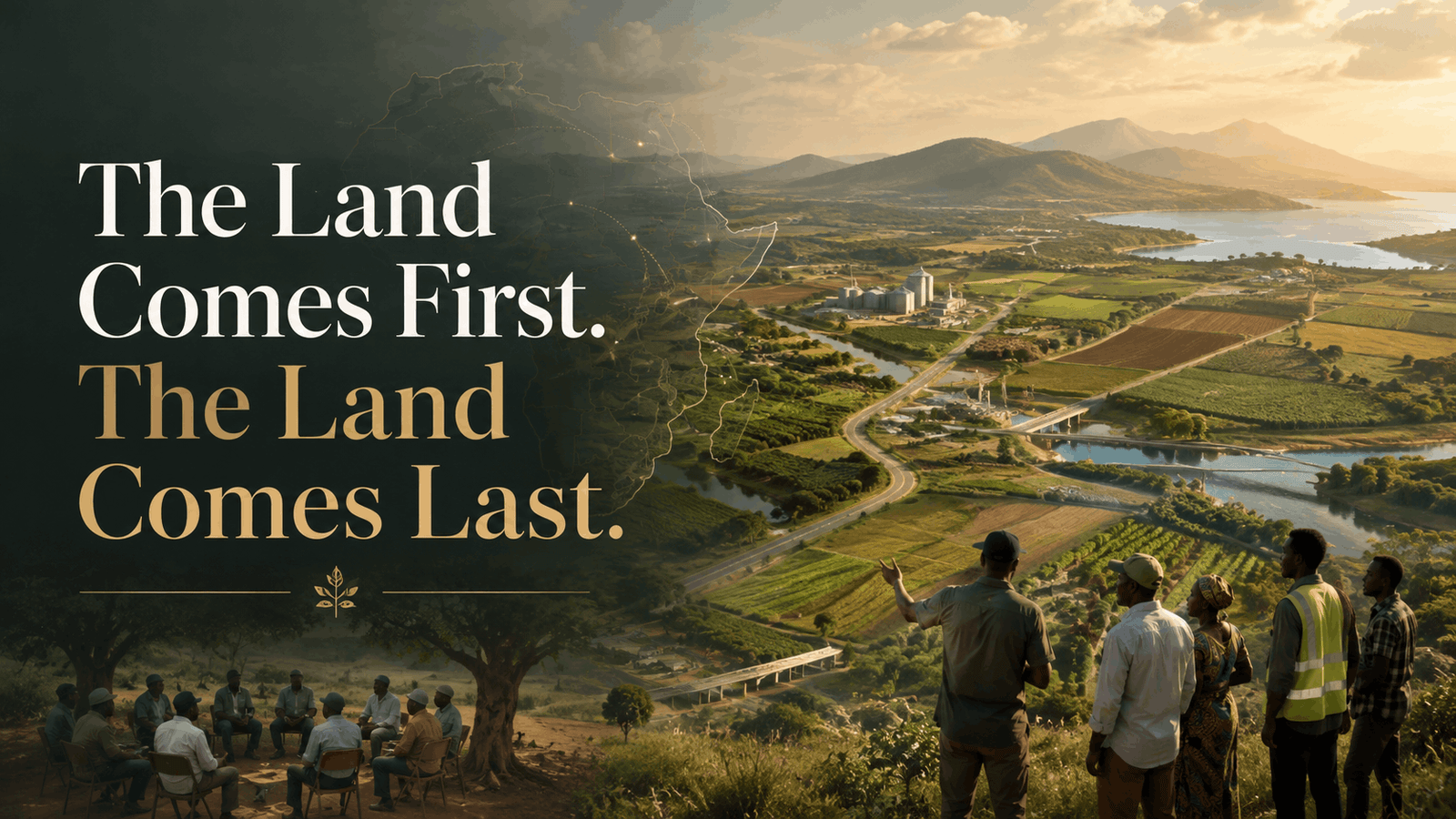
When people think about large-scale agricultural development in Africa, the conversation almost always begins with land.
- How much land is available?
- Where is it located?
- How quickly can it be secured?
These are natural questions. After all, land is the foundation of any agricultural project.
Yet after years of involvement in the development of large-scale agricultural initiatives, I have come to believe that one of the biggest mistakes investors and operators make is assuming that land is the starting point.
In reality, successful projects are rarely built around land alone. They are built around people, relationships, infrastructure, geography, social priorities, long-term development objectives, and countless other factors that ultimately determine whether a project succeeds or fails.
The land may be the first thing people see on a map. But in practice, it is often the final result of a much larger process.
Looking Beyond the Boundaries
One of the most common mistakes in agricultural development is identifying a large tract of land and then attempting to design a project around it.
The more effective approach is often the opposite.
- Before selecting land, it is important to understand the project itself.
- What crop is being considered?
- What processing facilities will eventually be required?
- How much labor will be needed?
- What transportation infrastructure exists?
- Where are the water resources located?
- What environmental constraints may exist?
- How will the project interact with surrounding communities?
These questions influence what type of land is suitable and, in many cases, whether a project is viable at all.
Land should not simply be available. It should fit within a broader development strategy.
Over time, we learned that agricultural projects work best when every piece of the puzzle fits together. Land, infrastructure, communities, environmental considerations, government priorities and commercial objectives must all align. When one element is ignored, the project eventually encounters obstacles that could have been avoided much earlier in the process.
A Land Bank Is Rarely One Landowner
Many people unfamiliar with African agricultural development imagine large land banks as a single continuous area controlled by a single owner.
The reality is often very different.
Large-scale development opportunities frequently involve multiple landholding families, numerous villages, traditional authorities, chiefdoms and local stakeholders. Each may have its own history, priorities and expectations.
The technical challenge of identifying suitable land is often easier than the social challenge of bringing together the various stakeholders who have legitimate interests in that land.
This is why relationship building cannot be treated as a secondary exercise. It must become a central component of the development process from the very beginning.
The strongest projects are not necessarily those with the largest land areas. They are the projects where stakeholders understand the vision, participate in the process and see long-term value in the outcome.
Development Begins From the Ground Up
Large projects are sometimes approached from the top down.
Developers engage institutions, secure political support, commission studies and then move toward local engagement.
While institutional support is important, our experience suggests that lasting projects are often built from the ground up.
The starting point should be the people who live on and around the land.
- Community leaders.
- Village representatives.
- Local stakeholders.
These individuals understand the realities of the area better than anyone else. They understand local history, local concerns and local opportunities. More importantly, they are the people who will ultimately live with the project long after development teams have moved on.
When support is built at the local level, the entire development process becomes more stable.
When local concerns are ignored, even technically sound projects can struggle.
Understanding What Communities Actually Need
One of the most important lessons we learned is that communities often evaluate projects through a completely different lens than investors.
Investors may focus on yields, processing capacity and financial returns.
Communities often focus on healthcare, education, roads, access to services and opportunities for future generations.
These priorities are not obstacles to development. They are part of development.
When communities believe that a project can contribute to improving quality of life, discussions become more constructive. Trust develops more naturally. Long-term partnerships become possible.
This requires listening before proposing solutions.
It requires understanding before negotiating.
And it requires recognizing that sustainable development is not only about agricultural production. It is also about human development.
Trust Is a Strategic Asset
In agricultural development, trust is often discussed as a social concept.
In reality, trust is also a strategic asset.
Projects that invest time in building strong relationships with landowners and communities often experience greater stability throughout the development process.
When trust exists, misunderstandings can be resolved more easily.
Concerns can be addressed directly.
Challenges can be discussed openly.
Perhaps most importantly, communities that genuinely support a project are less vulnerable to external groups seeking to create division or conflict.
Trust cannot be created through documents or presentations. It is built through consistent engagement, transparency and respect over time.
Like any valuable asset, it requires investment.
The Importance of Local Presence
No amount of remote management can replace local presence.
- Agricultural development is ultimately a people business.
- Relationships matter.
- Conversations matter.
- Visibility matters.
The most successful projects typically have people on the ground who understand local dynamics, maintain relationships with stakeholders and remain engaged throughout the development process.
- Problems are identified earlier.
- Concerns are addressed faster.
- Trust develops more naturally.
- Local presence demonstrates commitment, and commitment is often one of the strongest signals a development team can send.
Returning to the Land
When people ask about agricultural development opportunities, they often begin by asking about land.
It is an understandable starting point.
But after years of experience, I have come to believe that the conversation should not stop there.
Successful land banks are not created by identifying hectares on a map.
They are created by understanding communities, building relationships, evaluating opportunities holistically and ensuring that every element of a project works together.
The land is important.
It always will be.
But the land alone is never the project.
In the end, the project begins with the land.
And it ends with the land.